
Choosing Commercial Landscaping Companies for Multi-Site Properties
Compare commercial landscaping companies across multiple properties with a practical process for defining scope, evaluating site fit, and reviewing proposals.
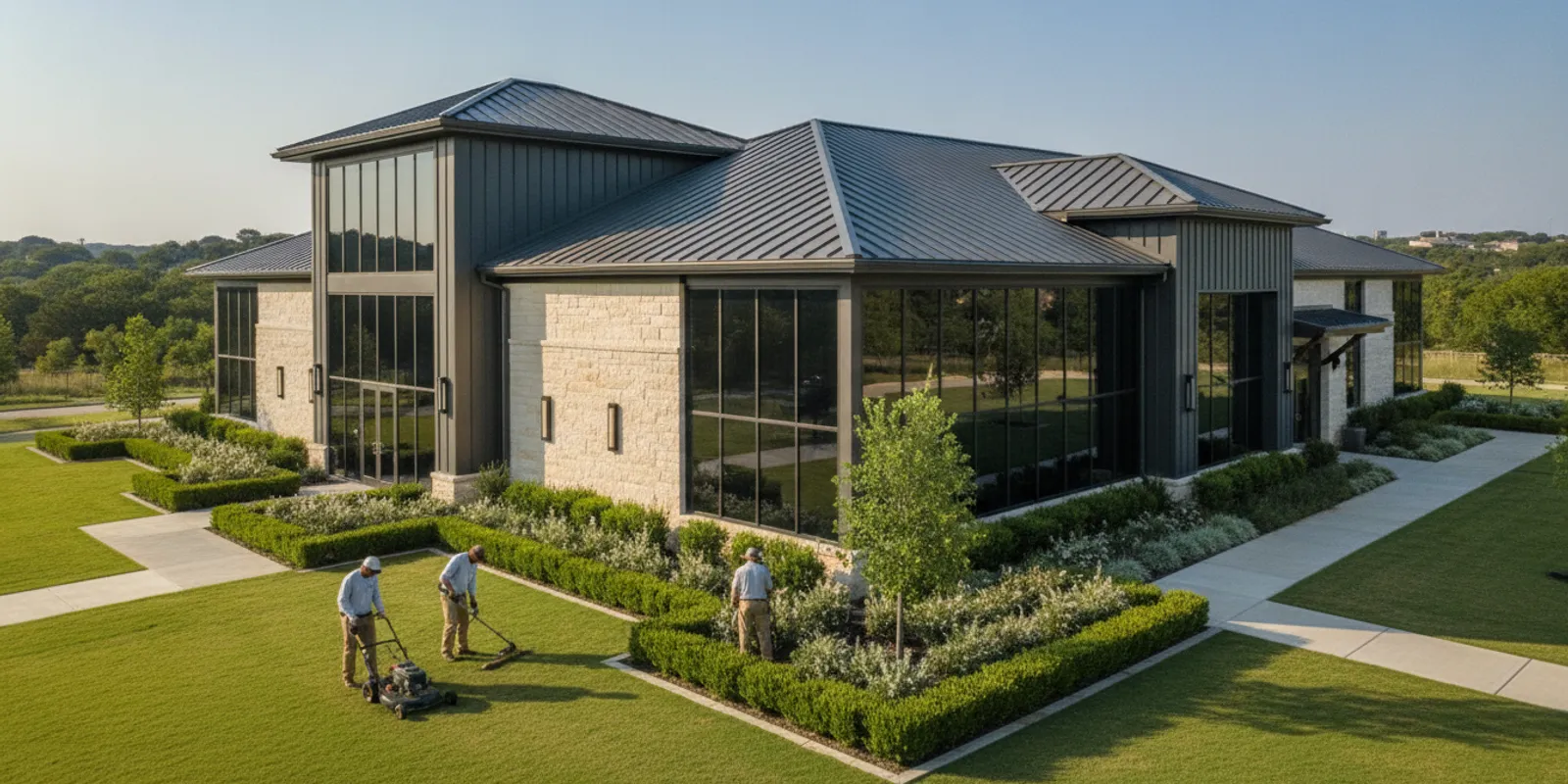
Choosing commercial landscaping companies for multi-site properties takes more than comparing a monthly rate. Each location can differ in grounds, access, use, and improvement priorities. A dependable selection process starts by defining what each property needs, then checks whether a provider can explain its proposed work, coordination, and reporting across the whole portfolio.
Discuss your commercial property project
For Texas owners and managers, commercial landscaping can mean recurring grounds maintenance, a defined landscape construction project, or both. These are not interchangeable scopes. A recurring service needs a repeatable schedule and a way to address site-specific exceptions. A construction project needs a defined outcome, decisions, and a process for changes. Keep those needs distinct as you evaluate providers, and ask each candidate to state clearly which work it is proposing.
This guide is about selecting a provider and organizing the comparison. It does not assume that every location needs the same work, that one company is automatically best for every property, or that a broad service description covers particular tasks. The goal is to give you a consistent method for learning what is included, identifying what remains uncertain, and deciding whether the provider’s approach fits your properties.
What should you define before contacting a provider?
Begin by building a short record for every property in scope. Similar-looking sites can have different uses or constraints. One may have public-facing entry grounds; another may have limited access windows or a larger landscaped area. Those differences should appear in the request for information, not emerge as surprises after proposals have been compared.
For each location, record its address, property use, grounds areas, known landscape elements, access considerations, and the person who can approve work. You do not need a perfect technical inventory to begin. The purpose is to give every candidate the same starting information and to mark uncertainties for inspection or follow-up.
- Identify the sites: Use a consistent name or site code for each property, and indicate whether it is included in the request.
- Describe the desired outcome: State what should be maintained, repaired, replaced, or improved. Avoid relying on a broad phrase when you can name the task.
- Separate priorities: Label essential needs, useful improvements, and optional work so providers do not treat them as one undifferentiated scope.
- Note operating constraints: Include access instructions, times when work may be disruptive, and any known site rules that affect scheduling.
- Name decision-makers: Identify who receives updates, who can authorize changes, and who should be contacted about a property-specific issue.
- Collect existing information: Share plans or photographs if available. Arrange a site visit when a condition cannot be evaluated from the information you have.
Next, distinguish routine maintenance from construction. List recurring tasks and their expected frequency separately from one-time improvements. Do not assume that a provider who proposes ongoing upkeep also proposes construction, or that a construction proposal includes continuing maintenance afterward. Ask the provider to identify the work it can address and the boundary between included tasks and separate project work.
For example, a property manager might want routine attention at three sites and a redesign or installation project at a fourth. Put the recurring work into a portfolio schedule and describe the fourth site as a separate project. If all four are grouped under a phrase such as “landscape service,” proposals may be difficult to compare: one candidate might price only repeat visits while another addresses both recurring work and an improvement.
How do you evaluate a provider across several locations?
A multi-site arrangement needs a portfolio-level plan and site-level detail. Ask how the company would coordinate the work overall while preserving the differences that matter at each property. A useful answer describes the contact route, how site instructions are kept, how schedules are communicated, and how completed work or open concerns will be reported.
Do not treat the number of locations a provider mentions as proof that it has capacity for your particular arrangement. Instead, ask about the proposed operating approach. Who coordinates the relationship? Who receives a request from a site manager? How does the provider distinguish a routine request from an extra task? How will you know whether work at each property is complete? The answers should be concrete enough for your team to understand what it must do as well.
Ask candidates to explain their assumptions rather than filling gaps with your own. If the proposal assumes the same visit frequency at every site, verify that this reflects your needs. If a provider has not reviewed an unusual site condition, ask what information is still needed. A clear statement of uncertainty is more useful than a confident-sounding proposal that leaves its basis unclear.
Researching local options and considering experience and references can help frame the evaluation. The University of Florida IFAS Extension’s guidelines for hiring a Florida-Friendly landscape professional recommend researching options and considering experience and references. Those guidelines address Florida, so use them as a general selection prompt rather than Texas-specific planting or maintenance advice. Ask for references or examples relevant to the type and coordination complexity of your own work, without treating a reference as a guarantee of future results.
What should you check about site fit?
Landscaping decisions should respond to actual site conditions, not just a portfolio-wide template. Walk the locations with the provider when possible, or share enough information for a site-specific review. Point out slopes, drainage concerns, heavily used areas, existing trees and beds, irrigation equipment if present, and areas where access is restricted. Ask what the provider observed, what it assumed, and what still needs inspection.
Plant suitability is a useful example of why site conditions matter. University of Minnesota Extension explains that plants should match growing requirements to site conditions. That is not a Texas planting guide, but it supports a practical question: what conditions and maintenance needs informed the proposed choices? For Texas-specific recommendations, ask the provider to explain the basis for its advice at each local site rather than applying a generic list or guidance written for another region without review.
Build a site-by-site matrix to make the differences visible. For each property, note which tasks apply, which do not, and what requires a decision. A matrix can be a spreadsheet or a simple table. Its value is not the format; it is the disciplined comparison. If a task appears on the portfolio checklist but not on one site’s proposal, you can ask whether the omission is intentional.
Use the same baseline information with every candidate. A provider pricing one visit frequency cannot be fairly compared with one pricing another. Likewise, a proposal that includes a defined project is not directly comparable with one that covers only recurring upkeep. Record exclusions and assumptions alongside the quoted scope, not in a separate note that may be overlooked later.
How can you compare proposals fairly?
Put the proposals into a side-by-side review. First check whether they cover the same properties. Then compare the tasks, frequency, project assumptions, and coordination process. Identify any phrase that could mean different things to different providers, such as “grounds service,” and ask for a task-level description. A lower total may reflect a narrower scope, fewer visits, or different assumptions; the written proposal should make the difference understandable.
| Comparison area | Questions to ask | What to record |
|---|---|---|
| Properties | Are all requested locations included? | Site list, omissions, and any conditions still to inspect |
| Scope | Which recurring and project tasks are included? | Task list by site, exclusions, and frequency |
| Site fit | What observations or assumptions shaped the work? | Conditions reviewed and unresolved questions |
| Coordination | Who handles requests, approvals, and schedule updates? | Contact route, roles, and reporting process |
| Changes | How are extra tasks or altered priorities reviewed? | Approval steps and documentation of the revised scope |
| Review | How will completed work and open issues be shared? | Update format, frequency, and site-level records |
Separate what is expressly included from what is optional or dependent on a later decision. Ask how the provider handles a new request that falls outside the agreed work. Clarify who can approve it, how the scope will be described, and how you will receive the information needed to decide. Do not rely on an informal verbal understanding when the change affects what is expected at a site.
References can add context, especially when they concern similar work or multi-location coordination. Ask what the reference property involved, what the provider was responsible for, and what kind of communication the client experienced. A reference can help you ask better questions, but it cannot prove that your sites will receive the same result. Keep the decision grounded in the candidate’s written proposal and your own requirements.
Compare clarity as well as scope. A proposal that identifies each property, explains its assumptions, and lists exclusions can be easier to manage than a shorter description that leaves important terms open. Clarity is not a guarantee of quality, but it gives both sides a shared basis for discussion. If a candidate cannot explain a material point, record it as unresolved rather than silently treating it as included.
What questions reveal how work will be coordinated?
Use the same questions with every candidate so the answers are comparable. Ask them in plain language and request an example of how the process would work for your sites. You are not looking for a polished promise; you are trying to understand what happens when normal conditions change.
- Who is the primary contact for portfolio-wide questions, and is there a separate route for a site-specific concern?
- How should a property manager report a missed task or a condition that needs review?
- What information will the provider share after a visit or project milestone?
- How are different schedules or instructions recorded when locations do not have identical needs?
- How does the provider flag work that appears outside the agreed scope?
- Who may approve a change, and how is that approval captured?
- What happens when access is unavailable or a site condition differs from the information provided?
Listen for a process that assigns responsibilities rather than shifting every task onto an undefined “team.” For example, a workable arrangement might identify one person on your side to consolidate non-urgent requests, while allowing a property manager to report an immediate site concern through a defined channel. The exact process can vary; what matters is that each person knows where a request goes and who can decide what happens next.
Ask how information moves in both directions. Your staff may know about a planned event, access restriction, or site change that affects the work. The provider may notice a condition that your team has not reported. Agree on how each side shares relevant information, and record the decision if it changes the scope or schedule. This is especially useful when several managers oversee separate locations.
What should the agreement and communication plan clarify?
Before work starts, make sure the written scope identifies the included properties and describes the work expected at each. It should distinguish recurring maintenance from construction tasks, state relevant timing or scheduling expectations, and identify exclusions or dependencies. If a location still needs a walk-through or a decision, record that as unresolved instead of presenting an assumption as settled.
Clarify how the agreed scope is maintained over time. If a property is added, removed, or changes in use, decide how that change will be reviewed and documented. If the work varies by season or site condition, ask the provider to explain how the expected tasks and timing are expressed. Avoid inventing a schedule on the provider’s behalf; the written terms should reflect what both parties actually agree to.
Agree on a practical reporting route. Property teams should know where to send a concern, who can authorize a change, and what details will be shared about work completed or still pending. Ask how the provider will flag a condition that differs from the original plan. A clear process helps the owner and provider resolve questions before they become competing assumptions.
- Confirm the property list and the version of the scope everyone is using.
- Document who can approve additional or changed work.
- Set expectations for schedule updates and site access.
- Keep site-specific notes attached to the relevant property.
- Record open questions, the person responsible for follow-up, and the next step.
- Review unresolved issues at agreed intervals instead of letting them disappear into email threads.
For a portfolio with several internal stakeholders, decide how approvals will be consolidated. If each site manager can request work but only one owner can approve extra tasks, make that distinction explicit. Otherwise, a provider may receive conflicting instructions or assume that a request is authorized when it is not. A short responsibility list can prevent this: identify who reports, who reviews, who approves, and who needs to be informed.
How should you monitor service across the portfolio?
Use a review routine that matches the size and complexity of your portfolio. Compare reported work with the agreed scope and track open concerns by property, owner, and next action. If several locations share a task, note whether the same standard applies at each one or whether a documented exception exists. This makes it easier to distinguish a recurring portfolio issue from a one-site concern.
Keep the monitoring record factual. Note the date, property, observed condition, relevant task, and what follow-up was requested. Avoid assuming the cause before the provider has assessed it. For example, if an area appears untouched, state where it is and what you expected under the scope. Ask whether the task was scheduled, completed, delayed, or excluded, and what the next step should be.
Review patterns as well as individual reports. If the same question recurs at multiple sites, consider whether the scope or communication process needs clarification. If only one property is affected, check its site-specific instructions and conditions. Do not automatically change the portfolio-wide scope to address a single-site issue; first determine whether the issue is local or reveals a broader gap.
When a problem appears, ask the provider to explain whether the existing scope covers it, whether further inspection is needed, and whether approval is required for additional work. Keep the conversation grounded in observations and the written agreement. If the team decides to change the plan, capture the decision and update the relevant site record so future reviews use the same understanding.
How should maintenance and construction needs be handled separately?
Recurring maintenance and landscape construction call for different kinds of comparison. For maintenance, focus on the repeatable work, frequency, property-specific variations, access, and reporting. For construction, begin with the intended outcome, site conditions, proposed scope, decision points, and the process for handling revisions. A provider may address both types of work, but your request should not blur their requirements.
Suppose a portfolio has three established locations and one site where the owner is considering a landscape improvement. Ask for the maintenance proposal to describe the ongoing work at all relevant properties. For the improvement, document the site, the result you want to explore, constraints, and any information that still needs review. Then compare the construction proposal on its own terms rather than folding it into a recurring service total without explanation.
One Real Roofer and Construction lists commercial landscape construction and commercial landscape maintenance among its services. You can review the services overview for the stated offerings and the commercial project information for its commercial context. These pages describe the company’s offerings; your specific project scope and fit still need to be discussed directly.
Keep expectations within the documented service description. Do not assume that a listed service includes a particular task, frequency, plant choice, design deliverable, or project result unless the provider confirms it for your situation. Ask what information is needed to define the work and how the agreed scope will be recorded. That distinction protects the comparison from turning a general service label into an unsupported promise.
What warning signs deserve follow-up?
A vague scope is a reason to ask for clarification, not necessarily a reason to reject a provider without discussion. Follow up when a proposal does not identify the locations, leaves visit frequency unclear, combines maintenance and project tasks, or fails to explain how changes are approved. Likewise, ask for detail when a broad assurance is not supported by a description of the actual process.
Watch for mismatched assumptions between your team and the provider. If your property manager expects a report after visits but the proposal says nothing about reporting, resolve that gap before work begins. If a company has not reviewed a site with unusual conditions, ask how those conditions affect the scope. If the proposal excludes a task your team considers essential, decide whether to revise the request or consider a different scope.
Another concern is an apples-to-oranges comparison. If one candidate covers every site and another leaves two sites out, the totals do not answer the same question. If one includes a project and another excludes it, the numbers are not comparable. Return to the shared site list and task matrix. Ask each candidate to confirm what its proposal covers before choosing based on a headline figure.
Be cautious about verbal assurances that are not reflected in the written scope. A conversation can help resolve ambiguity, but the final terms should record what was agreed. If a point remains uncertain, mark it as a condition to resolve rather than treating it as a commitment. This gives you a clearer basis for a decision and for future reviews.
How can you take the next step?
Prepare three items before requesting proposals: a site list, a consistent description of the work you want considered, and a short question set about coordination and reporting. Ask every candidate to identify what it knows, what it assumes, and what requires a site review. Compare written responses against your priorities, and keep recurring maintenance separate from any construction need.
A practical sequence is to document the sites, decide which tasks are recurring and which are project-based, share the same information with candidates, arrange reviews where conditions are unclear, compare scope and exclusions, and resolve open questions in writing. Then identify the contact and approval process your team will use once work begins. This sequence is useful whether the portfolio contains a few sites or many, because it prevents key decisions from being hidden inside a general service description.
One Real Roofer and Construction serves residential and commercial customers in Texas, including Dallas–Fort Worth, and lists commercial landscape construction and maintenance among its services. To discuss a commercial property need, you can contact the company or review its commercial service information for its roofing scope. Keep the inquiry specific about whether you are seeking landscape maintenance, landscape construction, or another project need.
Frequently asked questions
Should I use one landscaping company for every property?
Not automatically. Compare each provider’s stated scope, coordination approach, and site-specific assumptions against your portfolio. One provider may simplify communication, but the right arrangement depends on the requirements at your locations and the work the candidate actually proposes.
What information should I send when requesting a proposal?
Provide the property list, desired tasks, preferred schedule if known, access constraints, and site-specific priorities. Ask providers to identify assumptions and request an inspection or site review where important conditions are unclear. Give every candidate the same baseline information.
How do I compare ongoing maintenance with landscape construction?
Treat them as distinct scopes. List recurring tasks and frequency separately from one-time improvements. Ask whether the provider proposes to perform each type of work and how project changes, approvals, and site-specific decisions will be documented.
How can I assess plant recommendations?
Ask what site conditions, growing requirements, and maintenance expectations informed the recommendations. Seek advice suited to the Texas location rather than applying guidance written for another region without review.
What if the properties do not need identical work?
Use a shared portfolio format but record each site’s tasks and exceptions separately. This lets you keep common requirements consistent without pretending that different properties have identical conditions, access, or priorities.
A consistent scope and site-by-site record make it easier to compare proposals, surface gaps, and choose an approach that fits the properties you manage.