What Is Commercial Roofing? How It Differs From Residential
Compare commercial and residential roofing, including roof design, materials, planning, inspections, and proposal questions for Texas property owners.
Commercial roofing and residential roofing both protect buildings from weather, but they are not interchangeable project labels. The property’s use, roof layout, drainage, equipment, access, and construction scope all affect the work. If you are deciding what to ask about a business property or a home in Texas, start with the actual roof and the outcome you need—not assumptions based on the word commercial or residential.
What is commercial roofing?
Commercial roofing means roofing work for buildings used for business, institutional, industrial, or other non-residential purposes. Offices, retail properties, warehouses, and other commercial buildings are examples. The term describes the property context. It does not name one material, one roof shape, or one standard construction method.
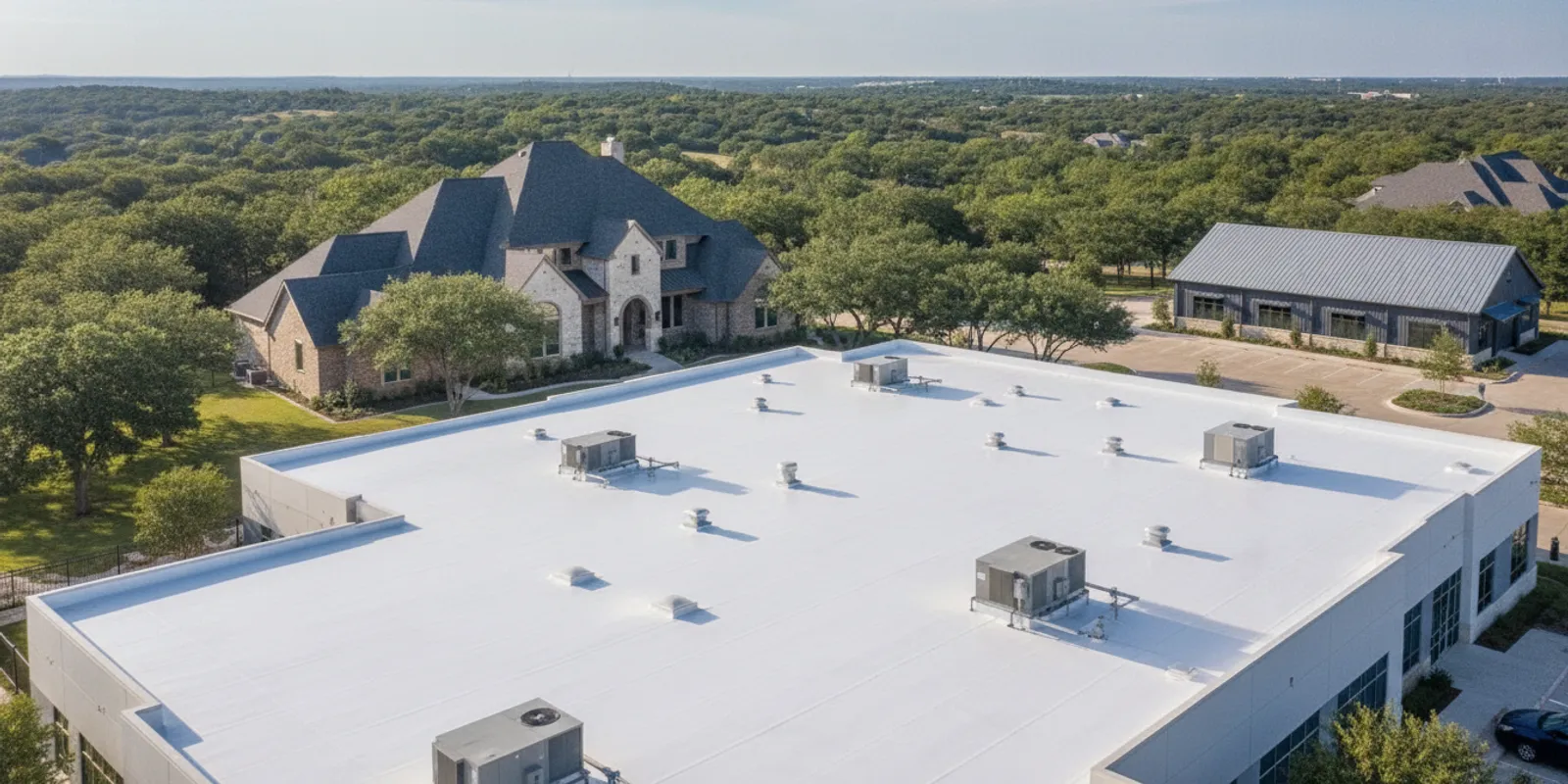
A commercial building may have a broad, low-slope roof, but that is not universal. Some commercial buildings have pitched sections or a combination of roof forms. A project may involve a membrane system such as TPO or modified bitumen (Modbit), or another assembly selected for the building and the defined work. Rooftop equipment, drains, edges, penetrations, access routes, and occupied spaces can also affect how the work is planned.
Commercial roofing can be part of new construction, replacement of an existing roof, or a repair or other defined project. The owner, property manager, tenant, general construction team, or other participants may have a role in decisions or coordination. Do not assume who approves the work or who receives updates. Identify those people at the start so questions and decisions have a clear route.
For a commercial owner, the useful first question is not simply, “Which roof system is best?” Instead ask: Which building area is under consideration, what is the project meant to accomplish, and what details of the property could affect the scope? Those answers make a later discussion of systems more meaningful.
What is residential roofing?
Residential roofing is work on homes and other residential buildings. Many homes have pitched roof planes, though a house can also have a low-slope addition or patio cover. Asphalt shingles and metal are among the systems used for residential projects. The design and material depend on the particular building and the work being considered.
A residential project often involves a homeowner or the person responsible for the property. That does not mean every home roof is small or uncomplicated. Multiple slopes, valleys, dormers, additions, roof penetrations, attached patios, and transitions between roof sections can all matter. Access to the house, household routines, landscaping, and the areas around the building may also need to be discussed before work begins.
It helps to separate the building category from the roof’s actual design. A home can include multiple roof forms; a commercial building can have pitched sections. The relevant description is the one that accurately captures the section being assessed. One Real Roofer and Construction provides information about its residential roofing services for readers who want to explore the home-focused side.
How do commercial and residential roofs differ?
The practical differences usually concern use, shape, drainage, system selection, access, and coordination. No single difference determines the right roofing system. A contractor needs to understand the actual building, existing conditions, and intended scope before discussing a recommendation.
Building use and coordination
A home project usually centers on the residence and the people who live there or own it. A commercial project may need to account for employees, tenants, customers, business operations, property management, or other construction work. Some businesses can adjust access during a project; others may have areas that need to stay available. These are project-specific questions, not assumptions that every commercial property has the same schedule or restrictions.
Before work is discussed, a commercial owner or manager can identify who approves the scope, who should receive updates, which areas need access, and whether tenants or other project participants need notice. A homeowner can similarly clarify household access, parking or yard use, and any areas that need special coordination. Clear communication does not decide the technical scope, but it can prevent basic planning questions from being missed.
Roof shape, drainage, and equipment
Many commercial roofs have a low slope and cover a broad area. Water movement and drainage points may therefore be central topics, along with seams, edges, penetrations, and rooftop equipment. A low-slope roof should not be treated as a featureless surface: details and transitions help define what the project must address. Some commercial buildings have pitched or mixed roof forms, so the actual site remains the guide.
Homes often have sloped planes that direct water toward eaves, but the number and intersection of those planes vary. Valleys, ridges, edges, penetrations, and connections between an original home and an addition can all shape the work. A home may also have a low-slope section. Ask how the proposed scope addresses the roof features that are actually present instead of relying on a general description of residential roofs.
Materials and system choices
Material selection is not a simple commercial-versus-residential rule. Commercial projects may use TPO or modified bitumen, while residential projects may use asphalt shingles or metal. These examples describe systems the customer offers; they do not mean each system suits every building. Ask which system is proposed for the specific roof and what project conditions support that choice.
Do not compare proposals by material name alone. A complete comparison considers the roof area, work type, relevant details, and assumptions behind the scope. If a proposal uses terms you do not recognize, ask for a plain-language explanation. Confirm whether it describes a repair, reroofing, new construction, or another defined task. Two proposals that mention the same material may still address different work.
Access and project boundaries
Access can shape planning on either kind of property. A commercial owner may need to clarify how occupants, deliveries, customers, or other work interact with the project. A homeowner may need to discuss driveway access, household routines, landscaping, or attached structures. The point is not to assume a particular disruption; it is to tell the contractor what conditions matter so the project conversation can address them.
Project boundaries matter just as much. A building can contain several roof areas, and a request may concern only one of them. Identify the exact structure or section under consideration. If adjacent work is not included, say so. A clear boundary makes it easier to ask whether the description, assessment, and proposal refer to the same area.
What should a commercial roofing assessment consider?
A useful assessment begins with the property and the owner’s objective. It should make clear which roof area is being discussed and what type of work is under consideration. On a commercial property, the conversation may include building use, access, project timing, and known coordination needs. A short written briefing helps the owner and contractor keep those details together.
- Project purpose: Is the discussion about new construction, reroofing, a repair question, or planning for a future project?
- Roof area: Which building sections are included, and are any areas outside the requested scope?
- Roof features: Which drainage points, edges, penetrations, equipment, and transitions are relevant to those areas?
- Property use: Will tenants, employees, customers, or other work be present during the project?
- Decision process: Who reviews the proposal, approves the scope, and receives project updates?
- Existing information: Are plans, previous assessments, or project documents available for the discussion?
- Known constraints: Are there access routes, operating needs, or other site considerations that should be raised early?
This list is a planning aid, not a substitute for an evaluation or a promise that every item applies. For example, an owner planning a reroof may already know which building area is involved, while a project manager preparing for new construction may be coordinating roofing with a wider sequence of work. The assessment should fit the actual building and objective.
One Real Roofer and Construction describes commercial roofing and commercial project work. Review its commercial roofing information and commercial projects page, then prepare questions about your own property. A service description can help you understand the kind of work offered; it does not establish the scope for a particular building.
What should a residential roofing assessment consider?
For a home, begin with what prompted the conversation. You may be planning a reroof, considering roofing for new construction, or asking about a roof concern. Explain what you know without deciding in advance that a particular material or scope is required. The assessment should relate the discussion to the actual house and the work being considered.
- Home and roof sections: Identify the property and any additions, attached sections, or patio areas relevant to the request.
- Visible features: Note the slopes, valleys, edges, and transitions you want included in the conversation.
- Project objective: Say whether you are considering reroofing, new construction, or another roofing need.
- Access and household needs: Discuss access to the property and practical constraints that may affect planning.
- Material questions: Ask what system is proposed and why it fits the building and defined scope.
- Follow-up: Ask what information you will receive and what decisions, if any, are needed next.
One Real Roofer and Construction lists free roof inspections among its services. A free inspection is not a promise that construction, every consultation, or every estimate is free, nor does it guarantee a particular finding. Ask what the inspection covers and what information you can expect afterward. The company’s broader roofing and construction services page can help you identify relevant service categories.
For example, a homeowner considering a roof replacement can first identify which structures are included, describe the questions prompting the conversation, and ask how the proposal will distinguish the work from any separate patio or addition. That is more useful than beginning with a material preference and assuming the same scope applies across every roof plane.
How does project planning differ?
Both types of project benefit from a defined scope, but coordination needs can differ. Commercial work may involve building operations, tenants, access, decision authority, or related construction activity. Residential work may involve household access and the use of the surrounding property. Neither checklist applies to every job, so discuss the actual conditions instead of assuming a standard process.
Before comparing proposals, write down a shared set of questions: What areas are included? What kind of work is proposed? Which system is specified? What assumptions affect the scope? What is explicitly outside it? For a commercial project, add questions about access and communication with the property team. For a home, add household and site considerations. Using the same core questions makes differences easier to spot.
On a larger construction project, roofing may be one part of a wider plan. One Real Roofer and Construction describes pre-construction consulting and project management for short-term engagements up to six months, as well as special-project support. Those services are not automatically part of every roofing project. Ask whether planning support is relevant to the project’s specific needs and what responsibilities it would cover.
When preparing for a conversation, separate known facts from open questions. A commercial manager might know the building must remain accessible but not yet know which work areas can be restricted. A homeowner might know a roof has several sections but not know how a contractor will define their boundaries. Record what is known, then ask who will confirm the remaining details and when. This keeps an uncertain item from being mistaken for an agreed project condition.
How should you compare roofing proposals?
Compare scope and clarity rather than relying on the commercial or residential label. The purpose is to determine whether proposals describe comparable work. Do not assume that two proposals cover the same tasks merely because they refer to the same building or material. If one is for a repair and another is for a reroof, they are different project types and need separate consideration.
- Confirm the property and roof area. Check that each proposal identifies the same building sections and boundaries. If one includes an addition and another does not, resolve that before comparing.
- Define the project type. Determine whether each proposal describes new construction, reroofing, repair, or another scope. Ask for clarification when the description is broad.
- Read the system description. Identify the roofing system proposed and ask how relevant roof details are included in the scope.
- Identify assumptions and exclusions. Ask what conditions or decisions could change the work being discussed. Do not assume an unlisted task is included.
- Review coordination needs. For commercial work, clarify access and communication with the property team. For residential work, discuss household access and site considerations.
- Ask how questions will be handled. Confirm who can explain the proposal, how decisions will be documented, and what information is needed before the next step.
Price should not be evaluated without scope. A lower figure may reflect a different area or set of tasks; a higher figure may include work that another proposal does not. Ask each provider to explain the differences in plain language. This is not a claim that a particular proposal is better. It is a way to make sure you understand what each one actually offers before making a decision.
Example: Suppose two proposals concern a commercial building, but one identifies a particular roof section while the other refers generally to the whole building. First ask each provider to confirm the area. Then compare the stated work, the system description, and the treatment of drains, edges, equipment, and transitions relevant to that area. Only after the boundaries match can you meaningfully discuss other differences.
For a home, the same method works with different details. If a proposal describes the main house but another appears to include an attached section, ask both providers to state the boundary in writing. Then clarify whether each is proposing a repair, replacement, or another task. Do not resolve a scope difference by assuming the shorter description includes more work.
What questions should property owners ask?
Good questions make the scope and responsibilities visible. Tailor them to the property. A commercial owner should include operational and communication needs; a homeowner should name the roof sections and household considerations. If answers remain unclear, ask for a more specific explanation before treating the proposal as a basis for a decision.
- Which roof areas are included, and which are not?
- What type of project is proposed, and what is its intended scope?
- Which roofing system is specified for this building, and why?
- How are drainage, transitions, edges, and penetrations addressed?
- For a commercial property, how are equipment and access considerations handled?
- What site conditions or decisions could affect the scope?
- Who is responsible for updates and for answering project questions?
- What should occupants, tenants, or household members plan for?
- What documents or decisions are needed before the next step?
- How will a change in the understood scope be communicated?
A useful answer is tied to the property rather than making broad claims about every commercial or residential roof. If two proposals differ, ask each provider to identify the exact difference in area, work, system, or assumption. You can keep a simple comparison note with four columns—area, project type, described work, and open questions—so the same points are reviewed consistently. The note does not replace the proposal; it helps you identify what needs clarification.
What about insurance-related roofing questions?
Property owners sometimes have questions about a roof and an insurance claim. Texas rules draw a line between a contractor’s construction role and the role of a public adjuster. A contractor may discuss technical information and estimates, but must not act as a public adjuster on property where it may perform work, negotiate a settlement, or file a claim for the policyholder. Contractors also must not waive, rebate, or absorb a deductible.
One Real Roofer and Construction describes help discussing the claim process and preparing or discussing contractor estimates. That is not a promise that the company will file a claim for you or negotiate a settlement. For guidance from the state regulator, consult the Texas Department of Insurance. Ask your insurer or an appropriately qualified professional about your policy and claim circumstances.
If insurance is part of the project, keep the construction discussion and claim decisions distinct. Ask for an estimate that describes the contractor’s proposed work. Do not treat a contractor’s scope as a guarantee of what an insurer will cover. Review the policy and communicate with the insurer or adjuster about coverage decisions. If the project has both a construction question and a claim question, identify which question each conversation is intended to answer.
When should you contact a roofing company?
Contact a roofing company when you are ready to discuss a defined property need: planning a reroof, a new construction project, a commercial roof assessment, or a residential roofing question. You do not need to select a system before starting the conversation. Useful information includes the property type, the Texas location, the building or roof area involved, and what you hope to understand.
One Real Roofer and Construction serves residential and commercial customers in Texas, including Dallas–Fort Worth. Its stated project model connects independent sales consultants, who build the customer relationship, with the company managing construction. Ask how that relationship applies to the project you have in mind, what the next step is, and which work is within the scope under discussion. The company’s about information provides another place to learn about its customer-facing approach.
To make the first conversation more focused, prepare a short description: “This is a \[home/business property] in \[area]. I want to discuss \[reroofing/new construction/another roofing need] for \[identified building section]. My main questions are \[two or three questions].” This does not commit you to a system or scope. It simply gives the company a starting point and helps keep the conversation centered on your project.
Contact One Real Roofer and Construction
Frequently asked questions
Is commercial roofing always flat?
No. Many commercial roofs are low-slope, but commercial buildings can also have pitched or mixed roof forms. The design and existing conditions of the particular building should guide the assessment.
Can a home have a commercial-style roofing system?
Roofing systems are selected for the building and project requirements, not solely by a residential or commercial label. Ask the contractor to explain why the proposed system fits the particular roof and defined scope.
Are commercial roofing projects always larger than residential projects?
Not necessarily. Commercial buildings may have broad roof areas and coordination needs, but size and complexity vary. A home can also have a complex layout or substantial work. Discuss the actual property rather than assuming scale from its category.
Does a free roof inspection mean the repair or replacement is free?
No. A free inspection offer does not mean construction work, every estimate, or every consultation is free. Confirm what the inspection covers and request clear information about any proposed work.
Can a roofing contractor file my insurance claim?
A contractor should not file a property claim for the policyholder or negotiate a settlement on a property where it may perform work. A contractor can discuss technical information and estimates. For claim questions, consult your insurer and the Texas Department of Insurance.
How can you take the next step?
Commercial and residential roofing share the goal of protecting a building, but its use, design, roof system, and project coordination shape the work. Start by identifying the property and the scope you need to understand. Then compare proposals by the areas and tasks they actually include, and ask for clarification wherever assumptions remain. A clear project conversation begins with the building in front of you, not a general label.