How to Install Roll Roofing: What Projects Require
How to install roll roofing depends on the product, slope, and building. See what to plan before a low-slope or commercial project starts.
People searching how to install roll roofing usually want a sequence they can follow. On a working building, that sequence is not one list. The product, the slope, the deck, and the way water leaves the roof all change the work. A shed roll and a commercial modified bitumen roll can share a name and still need different tools, weather windows, and safety plans.
Call (817) 677-6822 to discuss your roofing project or review commercial roof systems.
This guide explains the decisions that come before anyone unrolls material. It is written for property owners and project managers in Texas, and for commercial properties in Oklahoma, Arkansas, and Louisiana. It is not a do-it-yourself manual, and it does not replace the sheet maker's instructions for a specific product.
How to install roll roofing depends on the building
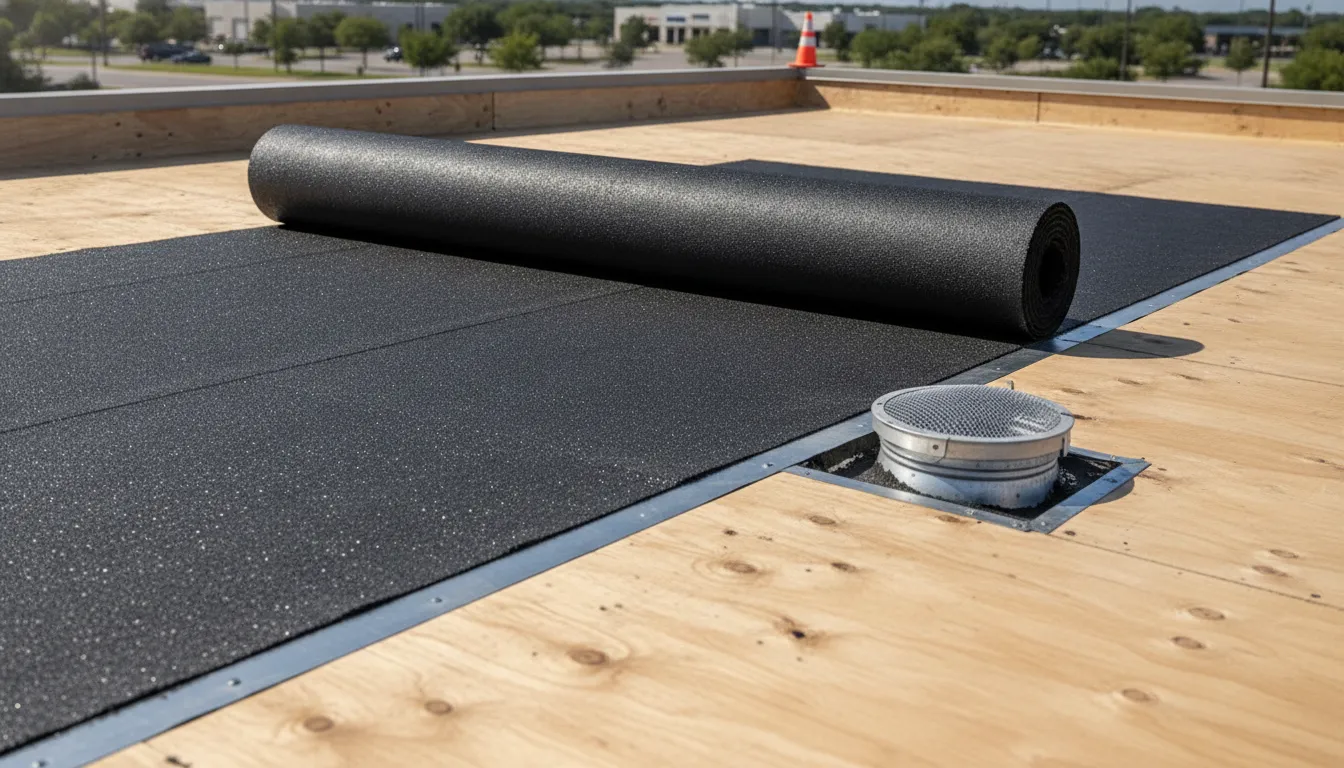
Roll roofing is a sheet that arrives in a roll and is laid in courses across a roof. That description covers more than one product. A mineral-surfaced asphalt roll used on a small outbuilding is not the same system as a polymer-modified bitumen sheet used on a low-slope commercial roof. One Real Roofer and Construction discusses asphalt, metal, TPO, and modified bitumen, also called Modbit, as options that depend on the property and the scope. Review the commercial roofing service and residential roofing service paths to keep those building types separate.
The useful first question is which roll you are talking about. A light asphalt roll is often a simple covering for a small, steep-enough surface. A modified bitumen roll is a thicker reinforced sheet. Industry descriptions of these sheets put many of them in a range around 120 to 170 mils, with some thinner self-adhering sheets near 60 mils. Typical roll widths are about 36 inches or a nominal 39 inches, which traces back to one-meter production. Those numbers describe the product family. They do not tell you which sheet belongs on your building.
Attachment is the next split. Some rolls are nailed. Some are stuck with a cold adhesive. Some are heated with a torch so the asphalt bonds to the layer below. Some are self-adhering once a release film comes off. Hot asphalt is another traditional method. Each method has its own temperature limits, crew skills, and fire or fume controls. Choosing the method from a general article, instead of from the product sheet and the building, is how projects get the wrong scope.
Slope decides layout. On a low-slope roof, sheets are usually started at the low point and worked uphill so water does not run against a lap. On steeper slopes, some modified bitumen instructions call for side laps to run with the slope so the sheet is less likely to creep. "Roll roofing" searches often skip this. The same roll laid the wrong direction can create a back-water lap even when every seam looks neat from a few feet away.
Which roll and attachment method fit the building?
Start with the building, not the roll in the aisle. A warehouse, a retail space, and an occupied office do not offer the same access, hours, or tolerance for odor, noise, or open flame. One Real's commercial work begins with how the property is used, who depends on it during the day, and what access the site actually allows. You can review the commercial projects page before discussing the building.
Use the comparison below to sort the common choices. It is a planning table, not a specification. The sheet maker's current instructions control the real install.
| Roll type | Where it is usually discussed | Common attachment | What changes the plan |
|---|---|---|---|
| Mineral-surfaced asphalt roll. | Small, simple roofs and some outbuildings. | Nails and roofing cement at laps. | Deck type, slope, and a use that may be too light. |
| SBS modified bitumen. | Low-slope commercial roofs. | Cold adhesive, hot asphalt, or self-adhered sheets. | Temperature, open time, and traffic during cure. |
| APP modified bitumen. | Low-slope commercial roofs. | Often torch-applied. | Open-flame controls, a fire watch, and the deck below. |
| Self-adhered modified sheet. | Detail work or a specified full system. | Pressure-sensitive adhesive after primer, when required. | Dust, moisture, and a deck warm enough to bond. |
TPO is a different low-slope family. It is a single-ply sheet, not a modified bitumen roll, and it is one of the systems One Real can discuss for a commercial roof. If someone is comparing a roll of Modbit with a TPO sheet, that is a system choice. Read the commercial flat roofing guide for that comparison, then bring the building back into the decision. Do not pick a roll because it is easier to carry.
A qualifying client may be offered a Class 3 roofing-protection upgrade. That phrase stays qualified on purpose. It is not a free add-on for every roof, it is not Class 4, and it is not a promise of an insurance discount. Ask what the written scope actually includes before you treat any upgrade as part of the roll install.
What has to be ready before the first roll is opened?
A clean, dry, sound surface is the starting condition in manufacturer guidance for modified bitumen. Dust, old loose surfacing, trapped moisture, and debris all interfere with a bond. On a reroof, "clean" also means knowing what is already there. A new roll laid over a wet or incompatible layer can look finished and still fail at the bond.
Deck type matters. Wood and plywood can take fasteners. Structural concrete and many precast decks cannot be nailed the same way, so the system may need an adhesive or another approved attachment. The employer, not the property owner, has to confirm that the surface can support the people working on it. OSHA's fall-protection rule says employees may work on a surface only when it has the strength and structural integrity to support them safely.
Drainage is part of readiness, not a punch-list item. Water needs a planned path to drains, scuppers, or gutters. A sheet that dams water at a lap will hold it there no matter how well the field of the roof looks. Edge metal, wall flashing, and penetrations are the other places water finds a gap. Industry install guidance treats laps and flashing as the details to check, not the field of the sheet alone.
Weather is a gate, not a preference. Cold adhesive needs a temperature range and time to set. A self-adhered sheet needs a dry, compatible surface. A torch needs a crew trained for that tool, plus a plan for the time after the flame is shut off. Johns Manville's Dibiten manual covers its own heat-welded modified sheets. It tells contractors to leave a knowledgeable person on site for at least one hour after heat welding stops. That person watches the roof and any attic for smoke or smoldering. That is one maker's rule for one system. It shows why finishing before lunch is not the end of a hot install.
Store the rolls the way the label says. A roll that has been flattened, wet, or left in conditions the maker forbids should not be forced onto the roof to save a delivery. Creases and damaged ends become leaks later, usually at a lap nobody wanted to waste.
How does the install sequence change with the roof?
The sequence below is the order of decisions, not a set of steps to follow with a torch or a nailer. Product instructions, local code, and the approved scope control the actual work.
- Confirm the product, the number of plies, and the attachment method in the written scope. A cap sheet is not the whole system when a base sheet is required.
- Confirm the deck, insulation, and any cover board. The roll is the visible layer. The assembly under it still has to match the system.
- Set the layout from the low point. Side laps and end laps need the overlap the sheet maker specifies, and end laps should be staggered when the instructions say so.
- Treat drains, curbs, pipes, and walls before you call the field done. These are the places a later leak is most often traced.
- Check laps while the work is fresh. On a heat-welded sheet, a heated trowel is one field check for an unbonded lap. Cold and self-adhered systems have their own checks.
- Keep people and equipment off a fresh adhesive bond until the maker's cure window has passed. A shortcut across a new roof can telegraph into a ridge or an open lap.
Slope changes that order in one important way. At or above the pitch named in the product instructions, often discussed around 2:12 for some modified sheets, the roll may need to run with the slope instead of across it. That is a layout decision made before the first course, not a correction after half the roof is down.
Occupied buildings add another constraint. One Real plans commercial work around access, deliveries, and the hours the building is actually in use. A torch, a kettle, or a solvent-bearing adhesive may be acceptable on an empty roof and a poor fit over an open dining room. Say that early. Changing the attachment method after the material is on the roof is a different project.
What a property owner can observe without getting on the roof
You do not need to walk the roof to start a useful conversation. Photos of the existing surface, a note about the building type, and the history of leaks or repairs are enough to frame the first call. Interior stains do not map one-to-one to the entry point, so avoid deciding the scope from a ceiling mark alone. A roof inspection is the place to sort those clues before a roll is ordered.
If a prior repair used a coating, a peel-and-stick patch, or a different membrane, say so. Compatibility is a real limit. A new roll does not automatically bond to every old surface, and some coatings have to be removed or covered with a layer the new system accepts.
Which safety and code questions belong in the scope?
Roll roofing looks approachable because the material is a sheet. The hazards are not approachable. Unprotected edges, heat, fumes, and lifts all sit outside a weekend skill set.
OSHA's construction rule, 29 CFR 1926.501, requires fall protection when an employee works at an unprotected side or edge 6 feet or more above a lower level. The listed methods are guardrails, safety nets, or a personal fall arrest system. Low-slope roofs have more options in that same section, and those options are limited. They are employer duties. They are not a suggestion that a property owner can skip protection because the roof feels flat.
Open-flame work adds a second hazard. Torch-applied APP sheets can ignite hidden material at edges, penetrations, and under the deck. The National Roofing Contractors Association publishes torch-safety guidance and a CERTA training program for this reason. If the scope uses a torch, the conversation should cover who is trained, what fire watch happens after the torch is off, and whether a cold or self-adhered system would fit the building better. OSHA's roofing-worker guidance also points employers to fall protection and training. It does not certify a crew, and neither does this article.
Local code and the manufacturer's current sheet still govern. A planning article cannot tell you fastener spacing, adhesive rate, or the lap width for the roll on your roof. Those numbers change by product. Ask for them in the written scope rather than copying a figure from a general guide.
One Real states a lifetime labor warranty as its own promise. That statement is not a description of coverage, transfer rights, or what happens if a material maker's warranty differs. Warranties are also not a reason to skip the lap and flashing checks above. A warranty conversation belongs after the system and the install method are clear.
When should a roll-roofing question become a project conversation?
A how-to search is often the moment before a scope decision. Move it into a planned project when the roof covers an occupied business. Do the same when the existing system is unknown, more than one building is involved, or drainage is in doubt. Heat or a solvent adhesive is another reason to slow down. So is a roll that ties into walls, equipment curbs, or another trade's work.
One Real Roofer and Construction handles new construction, reroofing, and commercial roofing. A dedicated general manager per commercial project is a company practice, not a promised outcome on every job. The commercial roofing page starts from the building you have. That may be a new build with plans in hand, or an existing roof with known conditions. For the broader schedule questions, the commercial roof installation guide covers new work and reroofs. Free roof inspections are offered. A free inspection is not a promise that every visit, estimate, or repair is free.
Bring the building type, the city, photos or records you already have, and the hours the property has to stay in operation. You do not need a measured square count to start. Repair versus replacement is a separate question. So is the broader picture in what a roofing membrane is. This article stays on the roll itself. That means which product, which attachment, which direction, and which conditions have to be true before the sheet goes down.
Insurance paperwork is a different path. One Real can discuss the claim process and contractor estimates with you. The company does not file the claim, negotiate the settlement, or absorb a deductible. If storm damage is what prompted the roll-roofing search, say that on the call so the inspection and the paperwork stay in their own lanes.
Call (817) 677-6822 or request a free roof inspection.
Frequently asked questions
Can I install roll roofing myself on a commercial building?
No. A commercial roll install can involve fall hazards at 6 feet, open flame or adhesives, and a system that has to match the existing roof. OSHA puts fall protection on the employer. Product instructions put the install method on the specific sheet. Use this guide to prepare questions, then hire a roofing contractor for the work.
Is roll roofing the same thing as modified bitumen?
Modified bitumen comes in rolls, so people use the names together. Roll roofing can also mean a lighter mineral-surfaced asphalt sheet for a small roof. The two are planned differently. Ask which product is in the scope before you compare prices or timelines.
Do you start at the top of the roof or the bottom?
On a low-slope roof, install guidance for modified sheets says to start at the low point and work uphill so laps do not face flowing water. On steeper slopes, some products instead run the side laps with the slope. The product sheet for your roll is the authority, because the cutoff pitch is not the same for every brand.
Does One Real install roll roofing in Dallas-Fort Worth?
One Real Roofer and Construction discusses modified bitumen and other commercial systems for properties in Texas, and commercial work extends to Oklahoma, Arkansas, and Louisiana. Residential roofing is discussed across Texas. The right system still depends on the building, so a free inspection is the starting point rather than a product picked from a search.
Will a new roll stop the leak I can see inside?
Not by itself. An interior stain shows that water arrived. It does not show whether the cause is a lap, a drain, flashing, or an older layer under the surface. An inspection should look at those conditions before anyone commits to a new roll.