Metal Roof vs Asphalt Shingles: How to Compare for a Texas Home
Compare metal roofing and asphalt shingles for a Texas property, including cost factors, appearance, upkeep, weather considerations, and questions to ask.
When weighing metal roof vs asphalt shingles, the right choice depends on more than appearance. Your roof design, budget, maintenance priorities, and plans for the property all matter, especially in Texas, where conditions vary from one region and building to another.
What is the basic difference between metal roofing and asphalt shingles?
Asphalt shingles are individual overlapping pieces installed in courses across the roof. Metal roofing is a broad category of systems made with metal panels or metal shingles. The exact products and installation details differ, so “metal” does not describe one uniform roof.
Both materials are used on residential roofs. Asphalt shingles are a familiar option in many neighborhoods, while metal can provide a different look and may be formed into panels or shingles. The comparison should be between actual systems that suit your roof—not just two generic labels.
Start by identifying what is being proposed. Ask whether the metal option is a standing seam panel, another exposed-fastener panel, or a metal shingle. For asphalt, ask what shingle type and product line are included. Then compare the complete roof assemblies, installation scope, and written terms.
The visible covering is only one layer of a roof system. Underlayment, flashing, edge components, fastening details, ventilation, and the condition of the roof deck all contribute to the finished assembly. Not every proposal will describe these elements in the same level of detail. A useful comparison spells out what is included and where the two scopes differ, rather than implying that the surface material alone determines the result.
For example, two estimates may both say “metal roof” but refer to different panel profiles, fastening approaches, or trim details. Likewise, an asphalt shingle proposal may specify a different product or installation scope from another. Those are not automatically equivalent choices. Ask for product information and project documents that let you identify the actual system, then compare each one against the same roof conditions.
If you are still sorting out the broader residential choices, see this Texas homeowner’s guide to residential roofing. It can help put the material decision in the context of the roof and project as a whole.
How do the initial costs compare?
In many projects, metal roofing has a higher initial price than asphalt shingles. But a useful comparison requires proposals for the same property and a clear scope. Roof size, shape, slope, edges, penetrations, tear-off needs, decking condition, product selection, and installation details can all affect the project total.
Metal systems differ in material, panel or shingle design, trim, and fastening approach. Those choices can change the labor and materials involved. Asphalt proposals also vary by shingle product, roof complexity, existing layers, and the amount of preparation or replacement work required. A simple price-per-square-foot comparison can conceal important differences.
Before comparing totals, make sure each proposal explains whether it includes:
- Removal and disposal of existing roofing, or installation over an existing layer if applicable.
- Inspection of the roof deck and how damaged or unsuitable decking will be handled.
- Underlayment, flashing, edge details, ventilation components, and other system materials.
- Transitions around chimneys, walls, valleys, skylights, vents, and other roof penetrations.
- Cleanup, site protection, and the process for documenting changes if concealed conditions are found.
- The specific product names, colors, finish, and installation details being offered.
- Written warranty information and the party responsible for each warranty.
A proposal that leaves these items unclear is difficult to compare with a more detailed one. Ask the contractor to explain omissions and allowances in writing. If an estimate assumes the existing deck is sound, clarify what happens if inspection during the work reveals a problem.
Consider a simple comparison exercise. If one bid includes tear-off, disposal, flashing work, and a defined process for replacing damaged decking while another leaves those items out or lists them as allowances, the lower total may not represent the same project. Ask each contractor to describe what happens when a concealed condition is uncovered and how approval for additional work is obtained. You do not need to predict every condition in advance; you do need to understand how the proposal handles uncertainty.
For a broader look at the factors behind a roof replacement estimate, read what can shape a roof replacement quote. The article does not replace a property-specific proposal, but it can help you prepare questions.
Do not choose based on an assumed payback period unless the calculation uses realistic figures for your roof, products, maintenance, and expected ownership period. Lower initial cost and lower total cost over time are different questions. Your own plans and the documented terms matter more than a general rule.
If you want to evaluate long-term cost, write down the assumptions rather than relying on a broad claim. Include the actual quoted initial cost, what each written warranty covers, any stated inspection or maintenance guidance, and the period you expect to own the building. Future repair needs and utility costs cannot be known exactly from a material label, so show them as unknowns rather than treating them as guaranteed savings. This keeps the comparison useful without promising a result that the available information cannot establish.
How can the roof shape and design affect the choice?
The roof itself can make one system more practical than another. A simple roof with broad uninterrupted planes presents different installation conditions from a roof with many valleys, dormers, hips, skylights, or intersections. Metal panels require details that suit the system and roof geometry. Asphalt shingles also need careful detailing at valleys, edges, walls, and penetrations.
Ask how the proposed material will work at each notable transition. A credible comparison should consider the actual roof rather than rely only on photographs of an ideal installation. If the property includes additions or sections with different slopes, ask whether each area needs a different approach.
Details matter because a roof is made up of connected planes and edges, not a single uninterrupted surface. On a roof with several valleys, for instance, ask what detail the selected system uses at those valleys and whether the proposal includes the needed materials and labor. Around a chimney or wall, ask how flashing is addressed. At eaves and rakes, make sure the edge treatment is part of the scope. The point is not to select a particular detail without technical guidance; it is to confirm that the contractor has accounted for the conditions on your building.
Also consider roof pitch and drainage. Different areas of one building may have different slopes, and the chosen system must be appropriate for the particular surfaces and transitions. If there is a low-slope section next to a steeper plane, do not assume one material or one installation method automatically applies to both. Ask the contractor to identify those areas on the proposal and explain how the planned assembly responds to them.
Also discuss the existing roof assembly. An inspection can help clarify visible conditions and identify questions about the deck, layers, drainage, flashing, and ventilation. An inspection cannot make concealed conditions certain before work begins, so ask how the project team will communicate if opening the roof reveals something different from what was visible beforehand.
One Real Roofer and Construction describes a relationship-led project approach: an independent sales consultant builds the customer relationship, and the company manages construction. When discussing any project, ask who will communicate with you, who manages the construction, and how changes or questions will be handled from start to finish.
What should Texas homeowners consider about heat and weather?
Texas is not one uniform climate. Sun exposure, shade, humidity, wind, hail exposure, local drainage, and the layout of a particular building can differ considerably. A material choice should be evaluated for the property and the full roof assembly, rather than treated as a universal response to “Texas weather.”
Roof color and surface properties can affect how a roof interacts with sunlight, but a material name by itself does not establish how much energy a particular home will use. The attic, insulation, ventilation, air leakage, windows, orientation, and household patterns also matter. Ask for product-specific information if energy performance is part of your decision, and be cautious about broad savings promises that do not explain their assumptions.
Virginia Cooperative Extension discusses roofing materials used in hot, humid climates, including asphalt shingles and metal. That resource offers background on material choices, but it is not a product recommendation for your particular Texas home. Read its overview of roofing considerations in hot, humid climates, then ask how the proposed products and assembly fit your property.
Severe weather should also be part of the conversation, without treating any roof as damage-proof. Ask what the selected product is designed and tested to address, what the written product documentation says, and what installation requirements apply. Product descriptions, warranties, and insurance decisions are separate matters; do not assume one guarantees the others.
It can help to separate what you know about the property from what you still need to verify. Note whether the roof has shade, nearby trees, areas where water collects, or existing signs of wear, but do not treat a ground-level observation as a technical diagnosis. Ask the contractor to explain any product-specific documentation and how it relates to the roof being proposed. If an energy claim is presented, ask which product, building conditions, and assumptions support it. A result from one roof or climate setup does not automatically predict another building’s outcome.
In the event of a suspected storm impact or leak, document what you can observe safely from the ground and arrange an appropriate roof assessment. Do not climb onto a roof to investigate. A professional inspection can help identify visible conditions and explain what may need further review. Learn more in this Texas property owner’s guide to storm damage roof repair.
Which material offers the look you want?
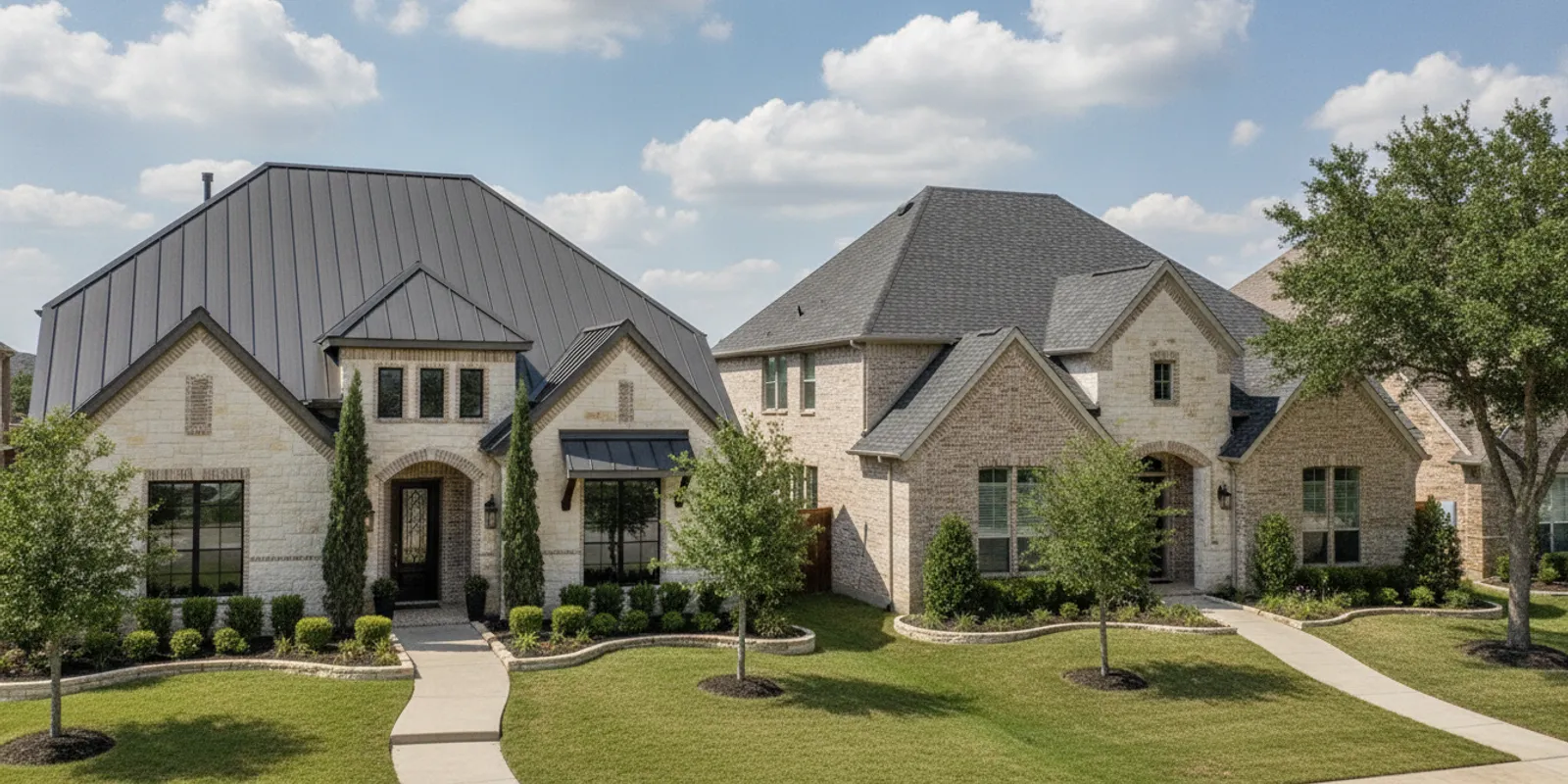
Appearance is a valid part of the decision because the roof has a large effect on a home’s overall character. Asphalt shingles come in different colors and profiles. Metal roofing can also have distinct finishes and forms, from long panels to shapes intended to resemble shingles. The available choices depend on the system and product line.
Compare samples in natural light and view them against the home’s siding, brick, trim, and surrounding landscape. A small sample may look different from a complete roof plane, so ask whether you can see photographs of installed projects using the specific product and color under consideration. Treat those images as visual references, not proof of performance on your house.
Check any applicable community or property requirements before making a final selection. If the building is part of an association or subject to design rules, review the written requirements rather than assuming a color or material is allowed. For commercial properties, consider how the roof choice fits the building’s function, appearance, and planned maintenance process.
For a more practical visual check, look at samples at more than one time of day and from the street as well as close up. Light and surrounding colors can change how a finish appears. If you are comparing a metal panel with a metal shingle-style product, remember that both are metal but create a different visual pattern. Likewise, two asphalt products can have different profiles and color blends. Keep the appearance comparison tied to the exact proposed product, not a generic photo of a similar roof.
What will maintenance and repairs involve?
Neither choice means a roof can be ignored. Useful upkeep starts with periodic observation from a safe location and a response when you notice a leak, displaced material, damaged flashing, or other change. A roof inspection can provide a closer look, but the right inspection interval depends on the roof, its age, conditions, and the property owner’s needs.
Repair details differ between systems. Asphalt shingles are replaced individually in some repair situations, though matching an older color or product can be difficult. Metal repairs depend on the panel or shingle design, fastening method, surrounding details, and the source of the problem. A visible mark does not always reveal the underlying cause, so ask for an assessment before deciding that a repair is simple or that full replacement is necessary.
For either material, keep project records together. Save the proposal, product information, installation documents, inspection notes, repair records, and applicable warranty paperwork. Note the date and location of any concern, and take ground-level photographs where safe. Organized records can make future conversations about maintenance or a later project more specific.
A simple record-keeping routine is useful whichever system you choose. Keep a copy of the final scope and the product details in one place. Add dated notes when a concern appears, identify which part of the roof is involved as precisely as you can from a safe vantage point, and save any assessment or repair documents. If a material or finish is discontinued, these records may also help a future roofer understand what was installed. Records do not guarantee that a repair will be possible or that a warranty applies; they make it easier to discuss the actual roof rather than rely on memory.
Ask who to contact if a concern appears after the project and what information is needed to review it. Warranty terms vary, so read the actual documents rather than relying on a general description. One Real states a Lifetime Labor Warranty as a company promise; ask for its written terms and do not infer coverage, exclusions, transferability, or a remedy beyond what the documents say.
How do you compare proposals fairly?
Use the same checklist for each proposal and ask for any material differences to be explained in plain language. A more useful comparison focuses on the proposed system and scope, not just the headline price.
- Confirm the product. Record the manufacturer and product line where specified, material type, profile, color, and finish.
- Compare the assembly. Review underlayment, flashing, edge details, fastening, ventilation work, and other components included in the scope.
- Review preparation. Check how tear-off, disposal, deck inspection, and concealed damage are addressed.
- Understand installation and communication. Ask who manages construction, who is your contact, and how schedule changes or discovered conditions are discussed.
- Read the written terms. Separate product warranties from labor commitments and understand what the documents actually state.
- Ask about exclusions. Identify work or materials not included, assumptions that could change the scope, and how changes will be approved.
- Keep a record. Request revised information in writing so you can compare the same version of each proposal.
Use questions such as these in a contractor conversation:
- Which exact metal or asphalt product are you proposing, and why does it fit this roof?
- How will the system be detailed at valleys, roof edges, walls, and penetrations?
- What is included in removal and disposal, and how will the roof deck be evaluated?
- What conditions could change the scope, and how will you explain those changes before proceeding?
- Which written documents cover the product and the labor, and where can I review them?
- What should I do if I notice a concern after construction is complete?
Try applying the checklist to one item at a time rather than making a quick judgment from the total. First compare product and assembly; next compare preparation and included work; then review warranty documents and exclusions; finally consider the price in light of those differences. If a proposal uses a broad phrase such as “complete roof replacement,” ask what that means for tear-off, flashing, ventilation, and any other work relevant to your building. Ask for revisions or clarifications in writing so the record remains clear.
A contractor discussion should also clarify the communication path. Find out who is responsible for project questions, how a change is documented, and when you will be asked to review an unexpected condition. These are practical questions for either material, since the project still involves site access, preparation, installation, and closeout. A clear explanation does not eliminate uncertainty, but it lets you compare how each proposed project will handle it.
For an additional checklist focused on the evaluation itself, see what a roof inspection can include. You can also review One Real’s roofing and construction services to see the residential and commercial work described by the company.
How do your ownership plans affect the comparison?
The time you expect to keep the property can shape how you think about the initial investment, but it cannot produce a reliable answer by itself. A higher upfront price may be more or less important depending on your budget, plans, maintenance preferences, and the specific products being compared. Avoid assuming a material will pay for itself within a particular period unless you have credible figures for your actual project and clearly stated assumptions.
If you expect to sell in the near future, consider whether the proposed roof matches the property and your priorities without assuming a particular increase in resale value. A buyer may care about condition, appearance, documentation, and remaining warranty terms, but no material alone guarantees a sale price or faster sale. Keep records of the work and make sure you understand what can be represented accurately to a future buyer.
If you expect to remain in the home for many years, you may place more weight on the product documentation, maintenance expectations, repair approach, and how the roof fits your property. That still does not mean that one material is automatically better over the long term. The actual system, workmanship, local conditions, and upkeep all matter, and future costs cannot be known precisely at the time of selection.
For a rental property or a building managed by someone else, include access and coordination in the decision. Consider how the owner will keep records, arrange inspections, approve changes, and communicate with tenants or a property manager. For a commercial property, the building's use and project schedule may also affect planning. A roof replacement is one part of a broader property decision, so allow time to review the scope and discuss practical constraints with the people responsible for the building.
Ownership planning also affects what information you should gather. A homeowner deciding for a long-term residence may prioritize appearance and a maintenance routine they can manage. An owner preparing a property for sale may want complete project documents available to explain the work accurately. Someone responsible for a rental or commercial building may need to coordinate access, operating hours, occupants, and the timing of the work. These are planning considerations, not reasons to assume a particular material will perform or sell better.
Budgeting should be based on written proposals rather than assumed market averages. If the proposals differ substantially, ask whether the difference comes from the product, system details, preparation, omitted work, or another project condition. Do not reduce a comparison to a payment or savings estimate that is not supported by the documents. Your goal is to understand the trade-offs well enough to choose with realistic expectations.
What should an inspection clarify before you choose?
An inspection can help connect the material discussion to the existing roof. Before settling on a system, ask what the assessment can establish from visible conditions and what may remain unknown until the existing covering is removed. This distinction matters because an estimate is prepared before every part of the roof assembly may be accessible.
Ask for a clear explanation of any visible concerns and where they occur. For instance, a question about a roof penetration, valley, or drainage area is more useful when tied to a specific location than to a vague description of the whole roof. Ask whether the proposal accounts for the observed condition and whether further review may be needed once work starts. You can then distinguish known scope from an allowance or a possible change.
Before the conversation, write down what you have noticed: a ceiling stain, a visible change in roofing from the ground, a recent repair, or a question about an addition. Do not climb up to take measurements or inspect a detail. Share the building’s renovation or roofing history if you have it, and gather prior proposals or product records. These materials give the contractor useful context without replacing an on-site assessment.
An inspection is also a chance to ask whether the roof includes distinct areas that should be evaluated separately. A home may have an older main roof and a newer addition, or a building may combine a steeper roof plane with a low-slope section. Ask the inspector to identify the areas, note their visible conditions, and explain which details need to be reflected in the proposed work. That makes the conversation more specific than choosing a material based on a general description.
How should you choose between metal and asphalt shingles?
Metal may be worth exploring if you prefer its appearance, are comfortable comparing a specific metal system, and find that its project scope and written terms fit your priorities. Asphalt shingles may be worth exploring if their look, product choices, proposal, and project requirements better suit your property and budget. Neither description decides the matter on its own.
Make the decision after comparing complete, property-specific proposals and reviewing the product documentation. Consider how long you expect to own the property, what level of initial spending is workable, how you value appearance, what maintenance process you prefer, and what the roof design requires. There is no single material that is automatically the right choice for every Texas property.
A practical final check is to summarize the decision in your own words. Identify the selected product, the work included, what the documents say about the product and labor, what is excluded, and how an unexpected condition will be handled. If any of those points remain unclear, ask for clarification before signing. This short written summary can expose a mismatch between what you expect and what the proposal actually includes.
Frequently asked questions
Is metal roofing always more expensive than asphalt shingles?
Not in every possible project, but metal often has a higher initial price. Product selection, roof shape, preparation, tear-off, and installation scope affect the total. Compare written proposals for the same property rather than relying on a general price rule.
Can you put metal roofing over asphalt shingles?
That depends on the roof, the proposed system, applicable requirements, and the condition of the existing assembly. Do not assume that an overlay is suitable. Ask the contractor to inspect the roof and explain in writing whether removal or another approach is proposed and why.
Does a metal roof make a home cooler?
Not automatically. Roof surface, color, insulation, attic conditions, ventilation, air leakage, windows, and other building characteristics influence indoor comfort and energy use. Ask for information about the exact product and assembly instead of assuming that the word “metal” predicts a specific result.
Are metal roofs noisy when it rains?
Sound depends on the complete roof and ceiling assembly, as well as the building. The material alone is not enough to predict what you will hear inside. Ask how the proposed system fits the existing construction and request product-specific guidance.
What should I compare first?
Start with the exact products, included work, roof preparation, flashing and other details, written warranties, exclusions, and communication process. Then compare the total price and how each proposal fits your property and plans.
The best choice is the roofing system you understand, can evaluate against the needs of your building, and can support with a clear written scope. Take time to compare the details before deciding.