
Commercial Roof Repair vs Replacement: A Decision Framework
Compare commercial roof repair and replacement by condition, scope, recurring issues, and building needs so you can plan a useful next step.
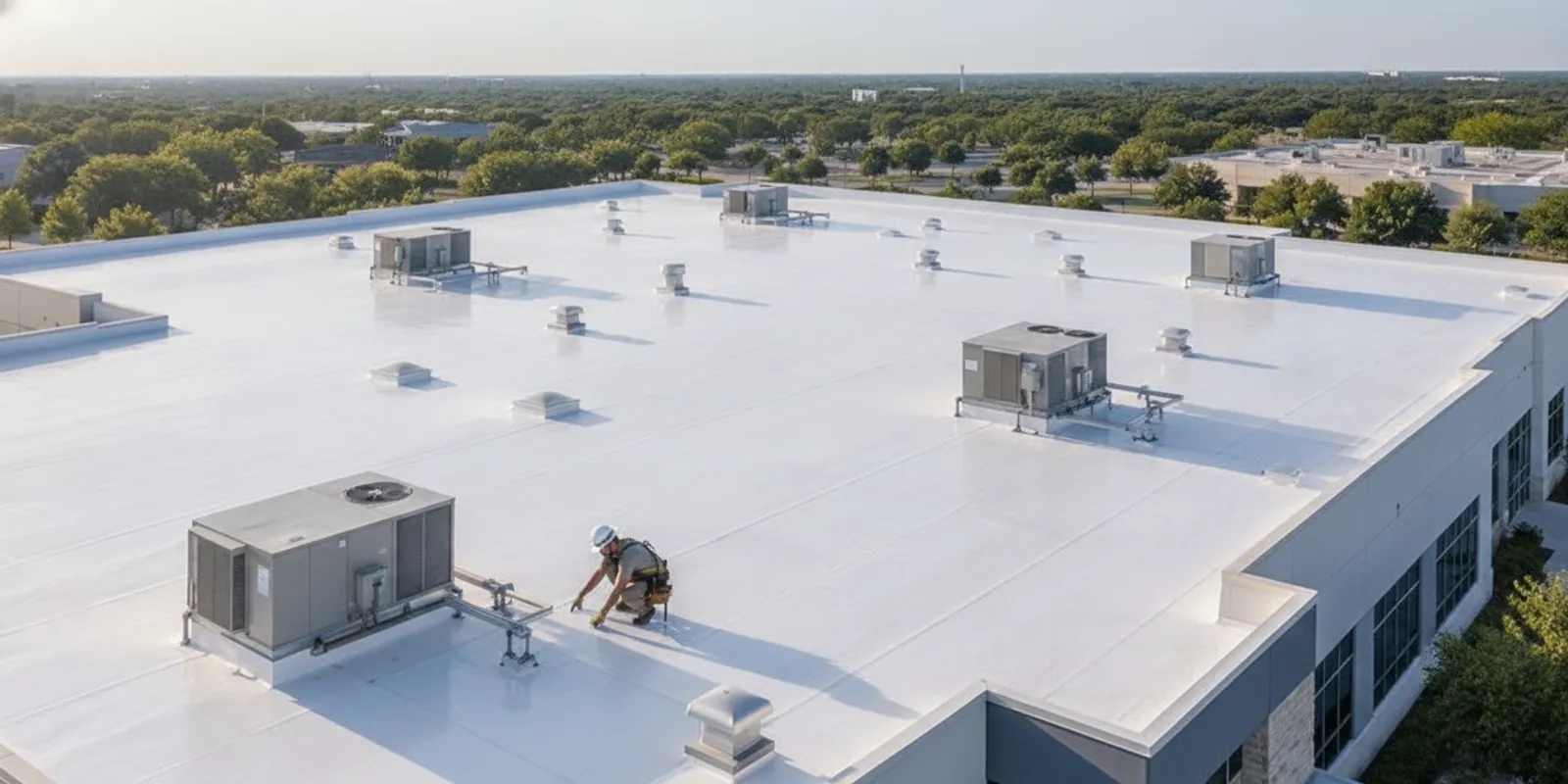
Deciding between commercial roof repair vs replacement starts with the roof’s condition, not a one-size-fits-all rule. A localized issue on an otherwise serviceable roof may call for a focused repair; widespread deterioration, recurring problems, or a project that needs a broader scope may warrant evaluating replacement. The right choice depends on an assessment of the roof system and the property’s needs.
Discuss your commercial roofing needs
For commercial property owners and project managers in Texas, the decision affects more than the surface material. You also need to understand what is known, what remains uncertain, how the building will be used during the work, and what each proposal includes. A disciplined comparison can help you avoid two opposite mistakes: assuming every leak means the roof must be replaced, or treating every repair as a complete answer to a broader condition.
This guide is a planning framework, not a substitute for a roof assessment. Do not climb onto a roof or handle materials to investigate a concern yourself. Collect information from safe locations and ask a qualified roofing provider to explain what was observed, what was not inspected, and how its proposed scope responds.
What does repair versus replacement mean for a commercial roof?
A repair addresses a defined area or condition. Its scope may involve correcting a particular defect or damaged section, based on what an assessment finds. Replacement is a broader project that removes and renews roofing across a defined area or roof assembly. The exact boundary can vary: a proposal might concern one portion of a roof or describe a larger project. Ask the contractor to identify the areas and layers included rather than relying on the word “replacement” alone.
Commercial roofs differ in design and materials. One Real Roofer and Construction lists TPO and modified bitumen (Modbit) among its roofing systems, as well as asphalt shingles and metal for applicable projects. System type matters because relevant details—including seams, transitions, drainage, rooftop penetrations, and existing layers—depend on the roof’s construction. The company’s commercial roofing services page provides a place to learn about its commercial work. Its guide to roofing membranes can also help explain common terminology.
“Repair” and “replacement” are not always the only possible next steps. An assessment may identify a need for more information, describe a limited repair for a specific condition, or outline a larger scope for consideration. Treat the recommendation as a conclusion that should be connected to evidence, not as a label to accept without explanation. If an area could not be accessed or a condition is concealed, ask how that limitation affects the recommendation.
Which signs suggest a repair may be worth evaluating?
A repair may be worth discussing when the concern appears limited and the rest of the roof seems serviceable. That is a starting point for evaluation, not a guarantee that a patch is appropriate. A visible leak identifies a symptom; it does not always show the full path of water or the condition of materials beyond the area where water appears. The location where a ceiling stain shows up, for example, may not by itself establish where water entered the roof.
- The concern is localized: The reported issue appears confined to a specific area rather than recurring across multiple parts of the roof.
- The roof has a defined defect: An assessment identifies a particular condition that can be addressed within a clear scope.
- The surrounding area is in usable condition: The proposal explains how nearby roofing and transitions were considered.
- The repair can be described precisely: You can see which area is included, what work is proposed, and what conditions could change the scope.
- The history is consistent with a contained concern: Records do not show a pattern of similar problems appearing in multiple areas, or the provider explains why the current issue is distinct.
Before choosing a limited repair, ask whether the recommendation accounts for the source of the problem, not just the spot where it became noticeable. A useful explanation connects the observed condition to the proposed work and states what the work will not address. For example, if the proposal concerns one transition, ask whether the assessment considered the nearby field of the roof and the relevant adjoining details. Do not assume that an item not named in the proposal is included.
Ask what you should watch for after the repair and what documentation will be available. This is not a request for a guarantee; it is a way to understand the purpose and limits of the work. If a similar symptom returns, a record of the original location, work scope, and timing can help the next assessment distinguish a recurring issue from a separate one.
When should replacement be considered?
Replacement deserves consideration when the assessment identifies broader deterioration, repeated issues, or conditions that make isolated repairs an incomplete response. It may also be useful to compare replacement when a property owner is already planning a larger roofing project. None of these points alone proves replacement is necessary. They are reasons to compare the available evidence and the scope each option would address.
- Problems recur: Similar concerns return after prior work, or issues appear in several areas.
- The affected area is broad: The proposed repair would cover a substantial portion of the roof or leave adjacent concerns unresolved.
- The roof system has multiple concerns: The assessment describes more than one condition that could affect the usefulness of a focused repair.
- A comprehensive project is already being planned: A reroof or other construction work may create an opportunity to coordinate scope and access.
- The proposed repair has important limits: The report explains that a repair would address a specific symptom but would not resolve other identified conditions.
Ask the contractor to distinguish observed facts from assumptions. “Water was reported near the loading area” is different from “the entire roof has failed.” A clear explanation identifies the inspected areas, the evidence supporting the recommendation, and any areas that were not accessible or evaluated. If a replacement scope is presented, ask why that extent is proposed and whether the recommendation applies to the full roof or a defined section.
Replacement is a larger decision than selecting a new surface. The proposed scope should explain what is removed, what is installed, what existing conditions might change the work, and which areas are not part of the project. The property owner can then decide whether the broader scope matches the evidence and project needs. Avoid assuming that two proposals with the same general label include identical work.
How can you compare the options?
Use the same decision points for each proposal. This makes it easier to see whether you are comparing a limited repair with another limited repair, or comparing different scopes altogether. The table is a planning aid, not a condition assessment or price estimate.
| Decision point | Repair option | Replacement option | Question to ask |
|---|---|---|---|
| Scope | Defined area or condition | Broader area or roofing assembly | Which exact areas and layers are included? |
| Condition basis | Evidence of a localized issue | Evidence supporting a wider project | What was observed, and where? |
| Open questions | Nearby areas or concealed conditions may remain | Access, existing layers, and project boundaries may need clarification | What is excluded or not yet known? |
| Building coordination | Coordinate access and work near the repair area | Plan access and operations across the broader work area | How will work affect entrances, tenants, or operations? |
| Records | Keep a description of the condition and repair area | Keep the larger scope, boundaries, and project sequence | What notes or photos will be provided? |
| Next step | Confirm the repair area and documentation | Confirm replacement scope and project sequence | What information is needed before approval? |
Do not compare proposals by the headline alone. A smaller scope and a broader scope answer different questions. If one proposal identifies a localized repair and another describes replacement, the difference might reflect different observations, assumptions, or boundaries. Ask each provider to explain the basis for its recommendation before comparing the proposals as though they were interchangeable.
Make a short comparison sheet with one row for each proposal and columns for the inspected areas, stated condition, work included, exclusions, unknowns, and building coordination. Fill it in using the proposal’s language. Mark unanswered items rather than filling gaps with assumptions. Then send the same clarification questions to each provider. This simple process helps a property owner or manager take a recommendation to other decision-makers without reducing it to a single headline.
What should a commercial roof assessment cover?
A practical assessment should help you understand the condition that prompted the inquiry and how the proposed scope responds. The detail needed will depend on the building and project. Ask whether the review considered the following:
- Roof areas: Which sections were accessed and observed? Were any areas inaccessible, and why?
- Reported symptoms: Where and when were leaks or other concerns noticed? Are there photographs or maintenance records?
- Roof system: What system is present, and what visible details affect the proposed work?
- Drainage and transitions: Were relevant edges, penetrations, drains, or changes in roof plane considered?
- Prior work: What repairs or maintenance are documented, and do they relate to the current condition?
- Interior observations: What indoor symptoms were reported, and how were they connected—or not connected—to the roof findings?
- Scope boundaries: What is included, what is excluded, and what could only be confirmed after work begins?
- Documentation: What notes, photographs, or written scope descriptions can be shared with the property owner?
One Real Roofer and Construction offers commercial roofing assessments and describes them as a way to understand roofing needs and replacement cost. A conversation can clarify what the particular assessment covers and what information is available for planning. Do not treat a preliminary observation as a complete account of concealed conditions unless the provider explains the basis for that conclusion. For other project-preparation considerations, see the company’s pre-construction planning guide.
Before the visit, prepare a simple map or description of the areas where problems were noticed. If your building has several roof sections, use familiar labels such as “north warehouse” or “office wing” and keep those labels consistent in maintenance notes. Share the dates of reported issues and the relevant records. This does not replace the inspection; it gives the assessor a clearer starting point and helps reduce confusion when several people report symptoms.
After the assessment, read the findings against the questions you asked. If the report says an area was inaccessible, ask whether the recommendation depends on conditions there. If it describes a repair, identify the boundary. If it describes replacement, identify what area the recommendation covers and what remains outside scope. A concise written clarification is useful when the decision will be reviewed by an owner, property manager, tenant representative, or construction project team.
How should you weigh repeat repairs?
Repeated repairs are a reason to review the history, but they do not automatically establish that replacement is the better choice. Gather dates, locations, descriptions of previous work, and available photos or invoices. Then ask whether the new concern is in the same area, appears connected to an earlier issue, or points to a separate condition. A roof history is more useful when each entry says what was observed and what scope was completed, rather than simply recording “roof repair.”
Consider a building where a leak has been reported twice near the same interior room. The records may show that the first repair addressed one defined location, while the second report describes water in a different area. That history calls for questions about both locations and the relationship between them; it does not by itself prove that the entire roof should be replaced. In another case, several similar reports in separate roof sections could prompt a broader assessment. The distinction comes from the findings and scope, not a fixed count of past repairs.
Discuss what each option is intended to accomplish. A repair proposal should identify the defined condition it addresses. A replacement proposal should explain why the broader scope is being considered. If the evidence cannot establish the full condition, the contractor should say what remains uncertain rather than present an assumption as a finding. Keep new observations and past work records together so later decisions can build on what was actually done.
What building and project details affect the decision?
The roof is part of a working property. A sound comparison includes the building’s use and the practical limits around access, timing, and coordination. These details do not determine whether repair or replacement is technically appropriate, but they help the property team plan a workable scope and ask useful scheduling questions.
- Occupancy: Are tenants, staff, customers, or visitors using the building during the work?
- Access: Where can workers and materials enter, and are there restrictions on rooftop access?
- Operations: Are there areas or times when noise, movement, or access needs coordination?
- Building activities: Are there loading, deliveries, or other operations that should be considered in a work plan?
- Project timing: Is roofing work tied to another construction project or a planned building change?
- Decision authority: Who needs to review the assessment, approve the scope, and coordinate with occupants?
- Communication: Who should receive updates if access or scope questions arise during the work?
For example, a repair may have a smaller physical scope but still require advance coordination around a particular entrance or occupied area. A broader project may involve more extensive planning across roof sections and building operations. Neither example tells you which roofing option is correct; both show why a proposal should address access and communication rather than only name the roofing work.
For multi-part work, clear responsibilities matter. One Real Roofer and Construction lists commercial roofing, pre-construction consulting, project management for short-term engagements up to six months, and special-project support. Confirm which service is relevant to your project and what the specific scope includes; do not assume every engagement includes every form of coordination. You can also review the company’s services to understand its stated offerings.
How can you compare commercial roofing proposals fairly?
Ask each provider to address a consistent set of questions. If possible, provide the same issue history and building constraints to each one. Consistent inputs make it easier to understand whether differences in recommendations reflect different findings or different assumptions.
- What is the recommendation? Is it repair, replacement, or further investigation, and what observations support it?
- What area is included? Ask for the roof section and boundaries to be identified clearly.
- What system and materials are named? Confirm that the proposed approach is described in terms that match the existing roof and stated project requirements.
- What is excluded? Ask what is outside the proposal and what conditions could affect the scope.
- What remains uncertain? Ask whether inaccessible areas, concealed conditions, or incomplete records affect the recommendation.
- How will the site be coordinated? Discuss access, occupied areas, and communication during the project.
- What documentation will you receive? Clarify what assessment notes, photos, or scope descriptions are available.
- What decision is needed now? Confirm whether you are approving an assessment, a defined repair, a replacement scope, or another step.
Do not rely on a vague statement that a roof “needs work.” A useful proposal explains the reason for the recommendation and lets you understand what decision it supports. If two proposals differ, compare their observations and inclusions before comparing totals. Ask for clarification when one uses a broad phrase such as “all necessary work” without naming the areas or conditions it covers.
It can help to separate the review into three passes. First, compare the condition evidence: what was observed, where, and how it relates to the reported problem. Second, compare the scope: areas, work described, exclusions, and open questions. Third, compare the project plan: access, timing assumptions, communication, and documents. If one proposal is missing information in any pass, request it before making a like-for-like comparison. This process does not require you to diagnose the roof; it helps you ask each provider to make its reasoning understandable.
What if the concern followed a storm or involves insurance?
Document what you observe and arrange an appropriate assessment. A storm or leak report does not by itself determine whether repair or replacement is needed, and an inspection should not promise a particular insurance outcome. Keep the roofing scope and any insurance decision distinct. The condition assessment concerns the roof and proposed work; coverage and claim decisions are questions for the insurer or agent under the relevant policy.
One Real Roofer and Construction can help discuss the claim process and prepare or discuss contractor estimates. The company must not be described as filing a claim for the policyholder, negotiating a settlement, or acting as a public adjuster. For general direction, consult the Texas Department of Insurance and ask your insurer or agent about policy questions and claim decisions. Keep copies of communications and contractor documents so you can share accurate information with the appropriate parties.
If the issue followed a storm, note the date when the concern was discovered, the locations affected, and any changes noticed afterward. Take photographs only from places you can reach safely. Avoid describing a suspected cause as a confirmed finding unless an assessment supports it. When discussing an estimate, distinguish the work the contractor proposes from decisions about what a policy may cover. This keeps the scope conversation clear and avoids treating a contractor’s estimate as an insurance determination.
What information should you gather before contacting a roofer?
A little preparation can make the first conversation more useful. You do not need to diagnose the roof yourself. Collect what you can safely access from building records and observations:
- Property address and the areas where concerns have been noticed.
- Dates or approximate timing of leaks, visible damage, or prior work.
- Photos taken from safe, accessible locations; do not climb onto the roof to document it.
- Available roof plans, maintenance records, previous scopes, and project documents.
- Building access requirements and any operational constraints.
- The decision you need to make and who else must review it.
- A list of questions about scope, exclusions, access, documentation, and next steps.
You can organize the information in a brief note: “The issue was reported in this area on these dates; these repairs are documented; these records are available; and these people need to review the recommendation.” Separate what you personally observed from what another person reported. That distinction helps an assessor understand which details are firsthand and which need confirmation.
When you contact a company, describe the symptoms and ask what the next assessment can and cannot establish. You can review commercial roofing services or the company’s commercial roof installation planning information if a broader project is being considered. For a general overview of the company’s work, its commercial projects page is another relevant reference.
How can a property team work through the decision?
For a property with several stakeholders, use a short sequence so that observations and approvals do not become mixed together. The building manager can collect the reported symptoms and records. A roofing provider can assess the accessible areas and explain its findings. The owner or authorized decision-maker can review the options, ask about exclusions, and decide what additional information is needed. Occupants can be given practical updates about access and timing without being asked to determine the technical scope.
- Log the concern: Write down where and when the symptom was noticed and who reported it.
- Gather records: Find relevant maintenance notes, prior scopes, photographs, and plans.
- Arrange assessment: Explain building access and ask what areas will be reviewed.
- Review findings: Separate observed conditions from assumptions and note any limits to the assessment.
- Clarify options: Ask how repair and replacement scopes would differ, when both are reasonable to compare.
- Plan communication: Identify who approves work and who needs information about access or operations.
This sequence is useful even when the next step is further assessment rather than immediate work. It creates a record of what prompted the decision and what questions remain. If the property has multiple roof sections, record which section each finding applies to; do not assume a conclusion about one area automatically applies to every part of the building.
Frequently asked questions
Can a commercial roof leak be repaired instead of replaced?
Sometimes. A localized, clearly defined condition may be a candidate for repair, but the source and surrounding roof condition need assessment. A leak alone does not establish which scope is appropriate, and the proposal should explain what the repair will and will not address.
Does a history of repairs mean the roof should be replaced?
Not on its own. Review where the repairs occurred, what they addressed, whether concerns returned, and what the current assessment finds. Compare the evidence and scope rather than relying on the number of past repairs alone.
Should I get more than one proposal?
Comparing proposals can help clarify different recommendations and scope assumptions. Give each provider the same basic information, then compare inspected areas, proposed work, exclusions, and open questions. Ask each provider to explain any difference in scope before you treat the proposals as directly comparable.
Can a roofer tell me whether insurance will pay for replacement?
A roofer can discuss roofing conditions and contractor estimates, but should not promise an insurance decision or negotiate a settlement for you. Ask your insurer or agent about coverage and claim determinations.
What if an assessment cannot confirm the full condition?
Ask which areas or conditions remain unknown, whether the recommendation depends on them, and what information would help resolve the question. A clear description of limits is more useful than treating an unconfirmed condition as established.
How can you take the next step?
Start with the condition, the evidence, and the scope needed to address it. A focused repair may make sense for a defined issue; replacement may merit evaluation when concerns are broader or recurring. Ask for a clear explanation of what was observed, what is included, and what remains uncertain before deciding. One Real Roofer and Construction serves residential and commercial customers in Texas, including Dallas–Fort Worth, and can help you discuss the needs of a commercial roofing project.
Review commercial roofing services
With a clear record of the concern and a well-defined proposal, your property team can compare repair and replacement as distinct scopes and choose an appropriate next step.